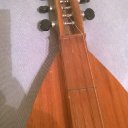
New Bill Berg dulcimer
Instruments- discuss specific features, luthiers, instrument problems & questions
Steven, enjoy your new dulcimer which I am sure you will.
Ken
"The dulcimer sings a sweet song."
Steven, enjoy your new dulcimer which I am sure you will.
Ken
"The dulcimer sings a sweet song."
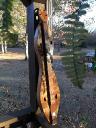
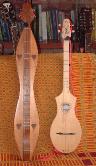
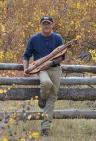
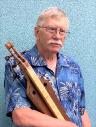
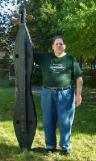
Received my new Bill Berg dulcimer the other day! It's an all sycamore 5-string long scale elliptical. It sounds wonderful, and looks great! Real nice people to deal with. Well, back to playing it!
Steven
Thany you every one. I will keep you informed,
. Any body ever use thr techniqe of whacking the butt end to determine moisture content?
The paraffin on the ends will keep the wood from drying too quickly. I dried some walnut in my unheated attic for several years. I just stacked and stickered it and left it there until I needed it for a project. Sounds like you are on the right track.
Ken
"The dulcimer sings a sweet song."
Yea, i won't put it near the fire place, just in the same room which geet warm enough. Also we use a small fan which generally keeps the air smoothly gently circulating.
Be careful, if it drys too fast it will be prone to checking and cracking.
Thanks Kusani,
pretty much what I figured too. We have a wood stove insert in the fireplace in our livingroom. Puts out nice dry heat. I think I may put the wood slabs in proximity and help speed up thr dryng process. Fresh cut wood smells the best no matter what kind it is!
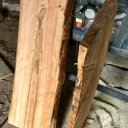
Nice looking pieces of wood! I would dry them 'as is' and then work them down to dimensions using whatever tools/machines you have available. Here is a slab of burl maple I air dried for 3+ years in a barn and then worked it down for making the dulcimer I have posted in another thread: 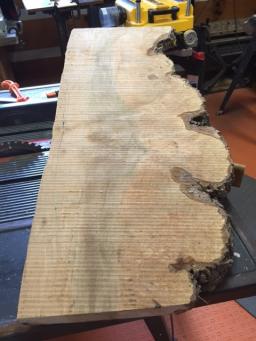
Hi, according to my past experiences I feel quite competent in building my first dulcimer. However, I know I will have several if not many questions and clarifications along my jouney. Here are the first.
In our woods a tree which I believe to be in the cherry or birch family came crashing down, broken off about 8 feet above the ground. A closer inspection revealed that downy woodpeckers and flickers were the culprits. My good fortune is in the remaining tree on the ground with about 10" diameter.
Using my chain saw I cut 2 slabs about 1.5x10x48 inches (+ or -) for top and bottom. At this time there are pretty rough and need band saw and planer attention. My question are about seasoning and drying the slabs.
1. Should I leave the slabs rough and let dry-out before doing any cutting ?
or
2. Should I band saw and plane to a rough size, then dry out?
In either case I will seal ends with parafin and bees wax.
I also cut a 3x3x48 inch maple plank from which the side will be band sawed from. I ask the same questions about drying out. No 1. Or No.2 ?
I also have a slab of black walnut which was shed off on one of our trees as a large branch came down in the wind. This has been in my barn for five years and completely dry. This will become the fret board and head.
I am extremely grateful to have such nice wood made available from my own land in such a natural way.
Any suggestion about drying are very welcome.
Lastly, can anyone recomend plans or a book for building the tear drop appalachian mountain dulcimer. I am pretty comfortable about the box. Need some good detail on head stock and stringing.
thanks all, will post pictures as I progress!
Tim Good Man
I'm not really sure what my first meeting with a Mountain Dulcimer was ... I was probably researching some of the old "Child" ballads and found either a video or recording that I liked the sound of, then spent some little while both convincing myself I really wanted one and then finding one at a price I wanted to pay ... they're a bit thin on the ground on the east side of the Atlantic, and, as everywhere, what might be considered a novelty item often commands a high price!
With instrument found and purchased I ended up with a "no-name" 4-string that needed a drop of glue and a new string ... the glue glued and the string got knotted (I didn't have a spare string long enough) and it gives me a great deal of pleasure :)
I was moved to join this friendly community because I saw the answers to the problems some of you'd had with Ken Hulme's tab and thought you might be interested in my workaround.
I tune my instrument DGD and play the 1+'s as a 3 (on the second string)!
This tuning also gives the opportunity to play some of the "4"'s on the melody string as an emphatic 444 chord, also some of the "0"'s as an 010 and at least one of the "3"'s as 323 ... these chords are optional, the original melody still works fine without them.
Hope this of interest to someone :)
I use my phone...which ain't all that good, but is simple.
Steven
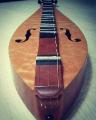
I have never seen a Bill Davis with the upper f holes, and only a couple that were done with heart holes, mine also has just the upper round ones, I'm attaching a couple of pictures of the signature, and the headstock so you can see the Davis looks quite a bit different. My understanding is, and I very well could be wrong on this, is that Davis was the "original" builder of the fiddle side design.
Looking at the photos you posted, I would still lean towards it being a Clemmer.
check USPS and UPS for the best rates. i found USPS the most reasonable. i reccomend the instrument be in a case packed with plastic peanuts
and then put in a box also packed with peanuts or crumpled newspaper.
Good to know about the Bill Davis fiddle shapes and kits; I stand corrected!
As was mentioned about Bill davis, it does look like his style, and he did sell kits, the ones he personally built were signed by him carving/engraving his name on the back side of the dulcimer, kits were not signed. I was fortunate enough to find a Bill Davis sometime back, signed that way but also carvet with the name of the person he built it for.
Otherwise I would also lean towards Mike Clemmer.
Either way a sweet one, I love the five strings, and as far DADisease, I am now up to 28, the dulcimers live in the house, if I add any more I'll be sleeping outside.
Just bought the Tascam DP 008ex. Do I know how to use it yet? Still reading. It is a 8 track recorder, they say cd quality.
The Henry Reed repertoire is treasure!
Though I never really got the B part of Poplar Pole nailed down, I love the tune.
I would definitely get the 8 1/2 fret. When I capo on the 3rd fret to play in the key of G, I see the 8 1/2 fret is like the 6th fret if I'm playing in D. This way it helps me to play the same chord shapes as if I'm playing in D. For example in D 0 6 5 is the 4th chord (G major) when capo up to 3rd fret. 0 8.5 7 is also the 4th chord (C major). Hope this makes sense.
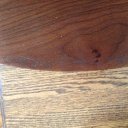
It looks like cherry in these photos, but it could be walnut with reddish lighting when the photos were taken.
Cherry looks deep orange or orange-red, and sometimes has small black "pitch pockets" here and there in the wood.
Walnut usually shows more grain, and can be medium- to chocolate-brown in color.
Hi Jill. I think the way you phrased your question actually answers it. The 8-1/2 fret is the octave of the 1-1/2 fret. So all the reasons you might want a 1-1/2 fret can be used to justify the 8-1/2 fret. When you are playing up there you might want those notes (minor thirds, 7ths. etc) that the fret offers. On the other hand, as you mention, frets get thinner up there and harder to use. That issue really depends on the dulcimer's VSL. The shorter the VSL, the thinner the frets. The other issue for beginners is that is is harder to identify where you are on the fretboard as you move higher up. My main dulcimer has a 28" VSL and I have no trouble with frets that are too thin until about 13. Everything below that is fully usable.
My advice would be to keep the two octaves the same. If you get a 1-1/2 fret, get the 8-1/2 fret. Otherwise you will have to recalibrate your thinking as you move up the fretboard. As you get used to the 1-1/2 fret your brain gets used to having those notes available, and then not having them in the upper octave will pose a mental obstacle. TO help identify frets up there you might ask for fret markers placed at the usual spots (frets 3, 5, 7, and 10).
Lisa, your impression of Alan is correct. His contribution to preserving and disseminating folk music; especially fiddle tunes, is tremendous. We owe him a great debt of gratitude for his hard and enduring work in this field. He will missed by family, friends, and colleagues. Rest in peace, Alan.
Ken
"The dulcimer sings a sweet song."
Jennifer, while I can not be certain, from the photos it does look like cherry. That would be my guess.
Ken
"The dulcimer sings a sweet song."
Alan was not only a wonderful fiddler, but he helped to preserve and bring deserved attention to the rich tune repertoire of Henry Reed. From watching him at a music camp, my impression was that Alan was not only a fine musician, but a real gentleman as well.
On Saturday at the Pocono Dulcimer Club Winterfest I encountered a similar dulcimer. The shape is the same. The peg head shape is slightly different. The pegs on the one I saw are wood, not mechanical friction tuners as in the photo here. The lower sound holes are identical, but the upper sound holes on the one I saw are round. Another difference is that the one I examined was made of wormy chestnut. There was no label inside. Bill Davis did sell kits but I do not know whether any of them were this style. This shape is also the shape used to make the "Masterpiece" dulcimer in Chet Hines book How to Make and Play the Dulcimore.
Ken
"The dulcimer sings a sweet song."
Bill Davis made kits for this style. I know, because I helped a lady repair hers. The head on his was different though-- it had chip carving on the sides of the scroll, and the end was larger. Too bad there's no label in it. Chet Hines wrote a book on how to build a "masterpiece dulcimore" like this.
Well, I had made contact with the seller & this morning again I asked where we could meet. Tonight, he said he sold it today. I guess I need to learn how to play, if something is listed - what I should do is be first at the door - don't e-mail & wait for a reply.
Thanks to all of you for all your help. It is disappointing to have lost the dulcimer but it was not a total lost - I have learn a good bit of history about Folk Roots, the Ruggs & the whole dulcimer movement in CA.
Hoping the dulcimer has found a good home & will be played.
Thanks again
That's no kit, believe me! No one I've heard of in 40 years has ever made a kit for the fiddle shape; it's not a simple build. It's not "vintage", that's for sure, but it might be a dozen years old. There should be a maker's label visible through (usually) the lower, far side sound hole. Mike Clemmer is the primary builder of that style, although a few others offer it. If the seller is only asking $100, snap it up -- tonight!